Rotoworld has come out with its top 150 prospects. In order to be eligible, players must have no more than 130 at-bats or 50 innings pitched in the majors. Also, they cannot have spent more than 45 non-September days on an active roster.
Here are some highlights:
1. Delmon Young - OF Devil Rays - DOB: 09/14/85 - ETA: Now
Previous rankings: 2004 #13, mid-2004 #4, 2005 #2, mid-2005 #2, 2006 #1, mid-2006 #1 .316/.341/.474, 8 HR, 59 RBI, 65/15 K/BB, 22 SB in 342 AB for Triple-A Durham
.317/.336/.476, 3 HR, 10 RBI, 24/1 K/BB, 2 SB in 126 AB for Tampa Bay
Young did little to enhance his stock after entering 2006 as the game's best prospect, but the drop in power and the pathetic walk rate weren't enough to cost him his placement. Neither was the ugly incident in April in which he threw a bat at an umpire and drew a 50-game suspension. There's no doubt Young is going to hit for power. He'll have 30- or maybe even 40-homer ability in his prime. Also, he makes contact often enough that he's not going to need to walk to be a very good player. He'll probably be a 50-walk guy someday anyway. It'd be quite a disappointment if he didn't go to at least a few All-Star Games in his career.
2. Alex Gordon - 3B Royals - DOB: 02/10/84 - ETA: Now
Previous rankings: 2006 #11, mid-2006 #3
.325/.427/.588, 29 HR, 101 RBI, 113/72 K/BB, 22 SB in 486 AB for Double-A Wichita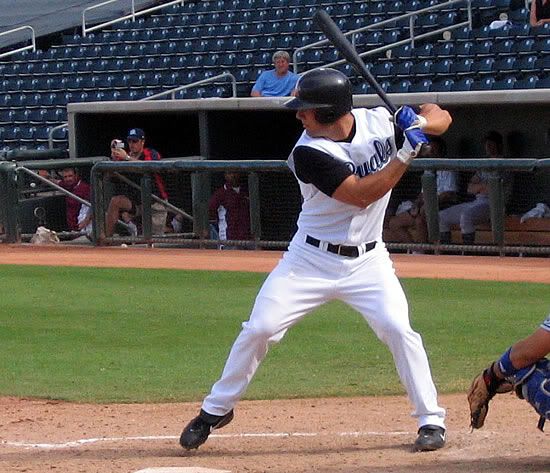 Mark Teahen had a breakthrough season in 2006, but he's about to get shoved to the outfield to make room for the Royals' best prospect in decades. Gordon signed too late to play in the minors in 2005 after being drafted second overall out of the University of Nebraska, but a solid showing in the AFL gave the Royals few reservations about having him begin 2006 in Double-A and he was one of the best players in the Texas League from day one. Gordon combines 30-homer power with some terrific on-base skills. It shouldn't be long before he's hitting .290-.300 in the majors, and he'll be a factor on the basepaths, though odds are that he's not going to last as a basestealer. With questions about his ability to stay at third base seemingly answered, he has a chance to be an MVP candidate at his peak. The Royals will give him every opportunity to make the team out of the spring training.
3. Philip Hughes - RHP Yankees - DOB: 06/24/86 - ETA: June 2007
Previous rankings: mid-2005 #47, 2006 #29, mid-2006 #6
2-3, 1.80 ERA, 19 H, 30/2 K/BB in 30 IP for Single-A Tampa
10-3, 2.25 ERA, 73 H, 138/32 K/BB in 116 IP for Double-A Trenton
Hughes, a 2004 first-round pick, emerged as the game's top pitching prospect in a 2006 in which he limited hitters to a .179 average and struck out nearly five batters for every one he walked. With plenty of movement on his 91-94 mph fastball and a curveball that's become a dominant second pitch, he has ace upside. His third pitch is a changeup that's a little above average. Since he doesn't have far to go when it comes to command, he'd likely have success in a major league rotation right now. The Yankees, though, would prefer to not have to turn to him right away. Barring injury, he should be up for good by midseason.
17. Jose Tabata - OF Yankees - DOB: 08/12/88 - ETA: 2010
Previous rankings: 2006 #136, mid-2006 #18
.298/.377/.420, 5 HR, 51 RBI, 66/30 K/BB, 15 SB in 319 AB for low Single-A Charleston
Tabata more than held his own as a 17-year-old in full-season ball, though he did decline rather than improve as the year went on. Part of the problem was a hand injury suffered in July. He later aggravated the injury in Venezuela, where he hit .275/.392/.422 in 51 at-bats. A center fielder initially as a pro, Tabata made the move to right last year and should stay there. He has a great idea of what he should be doing at the plate for someone so young, and he's likely to develop 30-35 homer power. While he's not going to reach the majors anytime soon, he looks like a potential star.
41. Dustin Pedroia - 2B Red Sox - DOB: 08/17/83 - ETA: Now
Previous rankings: 2005 #61, mid-2005 #27, 2006 #23, mid-2006 #30 .305/.384/.426, 5 HR, 50 RBI, 27/48 K/BB, 1 SB in 423 AB for Triple-A Pawtucket
.191/.258/.303, 2 HR, 7 RBI, 7/7 K/BB, 0 SB in 89 AB for Boston
The general view seems to be that Pedroia's stock has fallen over the last year, but after a slow start brought on by a shoulder injury suffered in spring training, he was productive as a 22-year-old in Triple-A, batting .330 and slugging .461 in 282 at-bats. Also, he showed terrific range at second base, the position that figures to be his long-term home. More than anything else, it was his arm that got him taken off shortstop. He did make the mistake of swinging for the fences too often after reaching the majors, but that's something time can take care of. The Arizona State product will be decent this year, and he should settle in as an above average regular beginning in 2008.
42. Jacoby Ellsbury - OF Red Sox - DOB: 09/11/83 - ETA: April 2008
Previous rankings: 2006 #138, mid-2006 #67
.299/.379/.418, 4 HR, 32 RBI, 28/25 K/BB, 25 SB in 244 AB for Single-A Wilmington
.308/.387/.434, 3 HR, 19 RBI, 25/24 K/BB, 16 SB in 198 AB for Double-A Portland
.276/.342/.371, 0 HR, 3 RBI, 16/8 K/BB, 7 SB in 105 AB for Peoria (AFL)
What Ellsbury lacks in offensive upside, he makes up for with potential Gold Glove defense in center field. The 2005 first-round pick out of Oregon State was one of the premier defenders in the minors last season, and he could offer just enough with the bat to be a leadoff man in the majors. The left-handed hitter shows gap power and the ability to hit for average. A few more walks would be nice, but at least he doesn't strike out very often. He'd probably be able to hold his own in the majors this year if Coco Crisp gets hurt again. A strong season split between Double- and Triple-A would make Crisp expendable next winter.
45. Clay Buchholz - RHP Red Sox - DOB: 08/14/84 - ETA: Aug. 2008
Previous rankings: mid-2006 #122 9-4, 2.62 ERA, 78 H, 117/29 K/BB in 103 IP for low Single-A Greenville
2-0, 1.13 ERA, 10 H, 23/4 K/BB in 16 IP for Single-A Wilmington
Buchholz was supposed to something of a raw product after getting drafted 41st overall out of a Texas junior college in 2005, but he's opened his pro career with a 2.47 ERA and a 185/42 K/BB ratio in 160 1/3 innings. Now it looks like the Red Sox could have him start this year at Double-A, though that's in large part because they don't want him to have to deal with the harsh environment at Lancaster in the California League. Buchholz works comfortably in the low-90s and has four pitches, though his curve lags behind his slider and change. As impressive as his command is, he would seem to have No. 2-starter potential.
56. Humberto Sanchez - RHP Yankees - DOB: 05/28/83 - ETA: Aug. 2007
Previous rankings: mid-2006 #29
5-3, 1.76 ERA, 47 H, 86/27 K/BB in 71 2/3 IP for Double-A Erie
5-3, 3.86 ERA, 50 H, 43/20 K/BB in 51 1/3 IP for Triple-A Toledo
After posting a 5.21 ERA at Single-A Lakeland in 2004 and a 5.56 ERA at Double-A Erie in 2005, Sanchez finally began to fulfill his potential last season, at least until he hurt his elbow in July. He made just one start over the final six weeks of the season. Sanchez has always had big-time stuff, but inconsistency, along with questions about his arm, has led many to believe his future may lie in the pen. It's more likely that he'll end up there now that he's a Yankee, the result of the Gary Sheffield trade. Sanchez can throw in the mid-90s and his hard curveball is quite a strikeout pitch. He'll probably reach the Bronx as a middle reliever before the end of the year.
92. George Kottaras - C Red Sox - DOB: 05/16/83 - ETA: April 2008
Previous rankings: mid-2005 #102, 2006 #89, mid-2006 #71
.276/.394/.451, 8 HR, 33 RBI, 68/50 K/BB, 0 SB in 257 AB for Double-A Mobile
.210/.286/.361, 2 HR, 17 RBI, 30/12 K/BB, 0 SB in 119 AB for Triple-A Portland Kottaras, who was picked up from the Padres for David Wells at the end of August, possesses rare on-base ability for a catcher and appears likely to develop 15- homer power.
His status as a prospect, though, hinges on his ability to stay behind the plate.
He's not fast enough to become an option at another key position, so if he has to move, he'd be a first baseman or a corner outfielder. Kottaras has enough of an arm to be an adequate catcher if he can make enough progress on the other parts of his game.
The Red Sox have no intention of having him change positions anytime soon.
Ideally, he'd make enough progress defensively this year that he could begin splitting time with the aging Jason Varitek in 2008.
97. Michael Bowden - RHP Red Sox - DOB: 09/09/86 - ETA: 2009
Previous rankings: none
9-6, 3.51 ERA, 91 H, 118/31 K/BB in 107 2/3 IP for low Single-A Greenville
0-0, 9.00 ERA, 9 H, 3/1 K/BB in 5 IP for Single-A Wilmington
Bowden was taken six spots after Clay Buchholz in the 2005 draft and the two are often compared to one another. Bowden has the advantage of youth and his curveball is probably a better weapon than any of Buchholz's offspeed pitches. Still, he gets dropped a bit here because of a delivery that could lead to arm problems down the line. Also, his changeup doesn't quite measure up. He has plenty of potential if his elbow and shoulder hold up. Still, it'd be no surprise if physical problems get him sent to the bullpen someday.
116. Daniel Bard - RHP Red Sox - DOB: 06/25/85 - ETA: 2009
Previous rankings: none
Top 150 Prospects


Globe suspends Borges
The Boston Globe has suspended sportswriter Ron Borges after learning that he plagiarized much of his football column this week.
The Globe's editor, Martin Baron, said in a story posted on the newspaper's Web site that Borges had included in his football notes column last Sunday material written by Mike Sando, a reporter for The News Tribune of Tacoma, Wash.
The allegations of plagiarism first arose on a Web site, coldhardfootballfacts.com:
Simply note the incredible similarities between his “Football Notes” column in the Boston Globe on Sunday, March 4, and this story written by Mike Sando and published in the News Tribune of Tacoma, Washington, on Feb. 25.Here are two sections of each story that you can judge for yourself:
We'll call a spade a spade here: Borges apparently lifted great stretches of his column from a previously published report. The question now is if his editors at the Globe will once again go to bat for him after another ethically malignant tumor of a column.
Sando:
But trouble arose in March 2004 when former Seahawks president Bob Whitsitt allegedly shorted Jackson on a contract offer. Jackson said he signed the deal anyway at the urging of his father, who has since died. Whitsitt has dismissed the charge as preposterous, while Ruskell has resisted honoring a promise that a predecessor denies making.Here is what Borges wrote:
The dispute has escalated ever since, with the Seahawks and Jackson’s agents exchanging a series of blunt letters, sources said.
When Ruskell became Seahawks president in February 2005, one of his first moves was to issue a letter to players outlining his expectations. He urged full participation in the team’s offseason program, including minicamps, but Jackson let it be known he would honor his contract but nothing more. Jackson subsequently skipped the voluntary portions of minicamps.
The relationship soured further after Jackson suffered a knee injury during an Oct. 2, 2005, game at Washington.
Jackson had bruised the knee earlier and experienced pain following a Sept. 25 game against Arizona. He suffered cartilage damage against the Redskins, raising questions in his mind about whether he should have been on the field at all, sources said.
The damage did not show up on initial tests. The team recommended rest. Holmgren avoided giving a timetable other than to say he thought it would be “shorter more than longer” after speaking with Jackson. The team ruled out Jackson for the next game.
Trouble arose with Seahawks management two years ago after former team president Bob Whitsitt allegedly shorted Jackson on a contract offer. Jackson said he signed the deal anyway at the urging of his father. Whitsitt has dismissed the charge as preposterous, while present club president Tim Ruskell has refused to honor a promise that another person denies making. The dispute has escalated, with the Seahawks and Jackson's agents exchanging blunt letters.
When Ruskell became Seahawks president in February 2005, one of his first moves was to issue a letter to players outlining his expectations. He urged full participation in the team's offseason program, including minicamps, but Jackson let it be known he would honor his contract, but nothing more. Jackson subsequently skipped the voluntary portions of minicamps.
Problems continued after Jackson suffered a right knee injury on Oct. 2, 2005, against Washington. Jackson had bruised the knee earlier in the season and he suffered cartilage damage against the Redskins, raising questions in his mind about whether he should have been on the field.
The cartilage damage did not show up on initial tests, and the team recommended rest. The team ruled out Jackson for the next game. Jackson, acting on the advice of his agents, sought a second opinion and later underwent surgery to repair the lateral meniscus in his right knee.
Pitching v. hitting prospects
Nate Silver has an interesting piece in Baseball Prospectus today in which he argues that hitting prospects are more likely to improve than pitching prospects.
"One thing that distinguishes young hitters from young pitchers is that young hitters can pretty much count on making steady improvements from the time they start playing professional ball until the time they’re 26 or 27.
The same is not the case with pitching prospects. Although there are a few categories of pitching prospects — particularly guys with good stuff, high strikeout rates and highish walk rates — that tend to improve more often than not, in general there is no systematic pattern of improvement after the age of 21 or so.
Sometimes guys get better, of course, and sometimes they do so in a hurry — but you can’t take a young pitcher in a vacuum and expect him to improve the same way that you can for a hitting prospect.
Young pitchers often take less time to become dominant big league performers. Pitching, somewhat contrary to the mad genius reputation of pitchers like Greg Maddux, is more of a purely physical skill and less of a learned behavior than hitting is. Pitchers like Francisco Liriano and Jered Weaver and Cole Hamels — these guys weren’t just holding their own last year, they were among the very best pitchers in baseball. Someone like Philip Hughes might very well be as effective today as he’s ever going to be, before he’s had a chance for injuries and mileage to accumulate. Keeping those guys down on the farm is not conservative — it’s a downright irresponsible way to run a ballclub.
Lester pitches again
Jon Lester pitched in game conditions for the first time since August.
As quoted by Nick Cafardo:
“There were some nerves.  I didn’t know where the first pitch was going to go, but it was a strike. ... I wasn’t worried about how many pitches or innings I threw; I just wanted to throw well and move on to the next step.”
"It's great. Just to get back and be normal again is awesome. Just to get back on the mound and throw the baseball and not worry about other things. So it's good and I enjoyed it and, hopefully, we just build from here."
On whether he was frustrated about not going beyond one inning: “No, I understand, I know that the team has my best interests at heart... I'll get my work in one way or the other, so we'll just take it slow and go from here."
Asked about the strength in his legs, Lester said that it wasn’t where it should be, but that he was about 85 percent to 90 percent there.
Lester will throw next in a bullpen session on Wednesday then pitch one inning Saturday in a simulated game against Boston teammates. With a very solid starting rotation, the Red Sox don't have to rush him.
Donnelly overtaking Pineiro?
Joel Pineiro was charged with four runs in 1 innings yesterday, giving him a 15.43 ERA through two spring appearances. The struggles might leave him with an uphill climb to overtake Brendan Donnelly in the closer’s race. The other top candidate, Julian Tavarez, pitched a
Donnelly has tossed two scoreless innings this spring.
“He’s not scared,” manager Terry Francona said. “He’s the kind of guy who wants the ball when the game’s still in doubt. We have room for guys like that.”
Manny Delcarmen had a rough day, giving up three runs in the top of the ninth inning that allowed the Phillies to break a 6-6 tie.
2 Manny notes
- Julio Lugo was spotted in spring training wearing a black shirt that read "Manny Being Manny" and had a bunch of Manny's statistics. Lugo said Ramirez gave out the shirts.
- Terry Francona on how he spent his day home with the flu:
"I was watching the Anna Nicole trial and looking to see if Manny showed up at that."
Pavano to be traded?
George King reports that the Yankees may be auditioning Carl Pavano to potential trade partners. As King notes, If the Yanks will swallow $15MM or so of Pavano's $23MM over the next two
seasons, they can clear a spot for Phil Hughes and pick up a prospect.
The Yanks (and lots of scouts) apparently believe Hughes is ready to be one of their best starters right now.
Pavano didn't embarrass himself or get injured facing the tough Phillies
lineup this afternoon. He faced off with Cole Hamels, allowing one run
in two innings of work. The Cardinals and Rockies have shown interest in
the past.
Pavano only recorded 16 strikes out of the 33 pitches he threw.
Schilling adds to arsenal
Curt Schilling has added a change-up to his resume: "It's been something I’ve worked on, meddled with for three years now and I think it’s to the point now where I can take it
and make it a plus pitch.”
Schilling said he threw 9 or 10 change-ups in the 3 1/3 innings he threw in the Sox 6-1 victory
against the Twins.
Unlike the changeup of Daisuke Matsuzaka or Pedro Martinez, each of
which breaks down, Schilling’s circle-grip changeup comes at the batter
straight, with little to no action. But by throwing with the same arm
action as his fastball, Schilling’s goal is to mess with the hitter’s
timing and get some bad swings that will translate into outs.
“I think it’s good enough to be my No. 2 pitch on some nights, that’s
why I’m starting to use it,” Schilling said. “It’s the pitch I can
strike people out with, get strikes with, it’s going to be an integral
part of my spring training and hopefully be an integral part of my
success this year. It’s a pitch that brings pitch counts down. You get
more contact, get quicker outs if you can command it and throw it in the
strike zone.”
Jason Varitek liked how hitters reacted yesterday.
“He threw some really good ones,” Varitek said. “The velocity was good
and there was good change of pace for him. The separation was good.”
