 Tonight's game has been moved up to 6 pm and the Sox face Orioles fireballer Daniel Cabrera.
Cabrera sports one of the top ten fastest heaters in the game and has had considerably more success this season as he has learned to trust his stuff and throw strikes.
Although he was a top strikeout pitcher last season, Cabrera ran into repeated problems with his control and ended up with a 5.55 ERA.
This season, Cabrera has simplified things and now lets his gas and plus slider get hitters out with balls near the strike zone.
As a result he has dropped over a run and a half off his ERA to 3.89.
Cabrera is primarily a fastball/slider pitcher and, as hit pitch selection chart shows, he relies on the fastball except when he is ahead in the count:
Pitch Type by Count:
      Fastball Slider
Count Total Percent Total Percent
0-0   252   91.97   22    8.03
0-1   102   87.93   14    12.07
0-2   37    90.24   4     9.76
1-0   105   88.98   13    11.02
1-1   88    86.27   14    13.73
1-2   65    84.42   12    15.58
2-0   39    90.7    4     9.3
2-1   51    85      9     15
2-2   58    71.6    23    28.4
3-0   11    100     0     0
3-1   21    100     0     0
3-2   46    86.79   7     13.21
His fastball averages between 94 and 95 mph and has pretty good life on it, with above average break in on a right-handed batter.
Cabrera throws the slider at 83, and while it isn't as impressive as his fastball, it has enough break and separation from the fastball to work quite nicely for him.
Look for Cabrera to throw fastballs early and often tonight. Here's a look atn his location chart:
Daniel Cabrera preview


Not Reinventing the Wheel
 Often today's baseball fans think they have some new way of looking at the game that escapes "Old-Time Baseball Men" like Joe Morgan and Tim McCarver.
Little did I know, but the venerable Brooklyn Dodgers exec Branch Rickey was advocating the use of on base percentage and isolated power over 50 years ago. Check out the following excerpt from an article Rickey wrote in 1954 for Life Magazine titled "Goodbye to Some Old Baseball Ideas." Here's a sample, for the rest, just click the title.
Even batting average must be reexamined. There are people who pride themselves on their ability to quote what Johnny Whosit hit the year of the big flood.
Among fans it is the accepted standard of excellence at bat. Why? Principally because it is easy to figure. Even the professionals lean upon it.
But batting average is only a partial means of determining a man's effectiveness on offense. It neglects a major factor, the base on balls, which is reflected only negatively in the batting average (by not counting it as a time at bat).
Actually walks are extremely important. Ted Williams, a student of batting values, bragged more about the 162 gases on balls he got five years ago than about his .343 batting average or his 43 home runs.
Wakefield Jr?
Kevin Goldstein checks in with his latest "Monday Morning 10-Pack" of prospects and has this to say about PawSox knuckleballer Charlie Zink:
Five years ago, Zink was quite the object of affection. He’s a knuckleball pitcher, which is an inherently cool thing in itself, but there was more as he was also an undrafted free agent out of the Savannah College of Art and Design, of all places. And his coach there was Luis Tiant-–I kid you not.
After earning far more attention that his talent really deserved, Zink established himself as what many saw as a Double-A/Triple-A lifer, being really good at times, but mostly compiling a lot of five-plus ERAs.
However, on Saturday night Zink got my attention with eight very good innings, allowing only one run on four hits, and a little further investigation shows that Zink has actually been good pretty much all year.
In 13 starts for the PawSox, he has an excellent 2.44 ERA while limiting International League hitters to a .204 average. While I’ve yet to talk to a scout about him, the knuckler seems to be knuckling of late, and maybe the 29-year-old Zink will be everyone's favorite knuckleball prospect again soon.
Grady Little vs Byung-Hyun Kim
 Patrick Sullivan of Baseball Analysts thinks Grady Little may be to blame for the flameout of Byung-Hyun Kim. Sullivan reminds us how effective Kim was for the Red Sox in 2003.
After being acquired for Shea Hillenbrand on May 29, Kim recorded 69 strikeouts and only 18 walks in 79.3 innnings - good for a 3.18 ERA and a 1.11 WHIP.
Not only that, but Kim was cruising heading into the playoffs, having been absolutely dominant down the stretch.
From September 1 onward, Kim held opposing batters to a .136/.208/.182. line.
That work was all but forgotten by the hometown fans when the Sox returned to Fenway down 0-2 to the A's in the ALDS. Hence his reception from the fans and the shot before the jump.
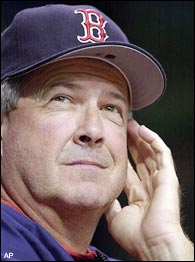 But was Kim really to blame for the Sox being in that 0-2 hole? As Sullivan explains it:
So what happened in Game One? Staked to a one-run lead heading into the bottom of the ninth, Little hands Kim the ball to nail the win down. He promptly induces a Ramon Hernandez fly-out before walking Billy McMillon and hitting Chris Singleton. With men on first and second, he then strikes out Mark Ellis. With two outs, two men on and his best relief pitcher on the hill, what does Grady do? He pulls Kim in favor of Alan Embree with lefties Erubiel Durazo and Eric Chavez set to hit.
Here's what Little might have considered; Embree that season yielded a .696 OPS against lefties, compared to Kim’s .664. Further, Kim had been Boston's Closer and had just struck out Ellis! With one out remaining and a one-run lead in the ninth, Grady opts for Embree, who promptly gives up a single to Durazo which plates the game tying run. Because the run is charged to Kim, he gets the Blown Save. Oakland wins in the twelfth.
Following the Game 3 incident with the fans, Grady benches Kim for the remainder of the playoffs. Kim was 24 at the time but has never been as good as he was in 2003 for the Sox.
Mike Lowell Interview
Baseball Prospectus's David Lauria has an interview with Mike Lowell. Some highlights:
On Ozzie Guillen telling him to hit the ball as softly as he could:
"Sometimes when you’re pressing, you want to get a hit so bad that you look like you’re almost squeezing the bat into sawdust. What he meant there was to just relax, and if you try to take as soft a swing as possible, you still have to take a swing. He actually said to do that in batting practice, and that I’ll see that my hands will be able to feel free and flow smoothly. It sounded like an extreme comment, but I think that the result was basically telling the player to just relax and take it easy.'June 1, 2008
Prospectus Q&A
Mike Lowell
by David Laurila
A World Series MVP, a cancer survivor, and a four-time All-Star, Red Sox third baseman Mike Lowell is one of the most highly-respected players in the game. He is also an author, having chronicled his life in the recently-released Deep Drive: A Long Journey to Finding the Champion Within. The book was written with Red Sox beat writer Rob Bradford, who covers the team for the Boston Herald and writes the insightful and sabermetrically-friendly Bradford Files blog. David talked to Lowell about one of the subjects he covers in Deep Drive: his approach to hitting.
David Laurila: Prior to the 2006 season you called Gary Denbo, who had been one of your hitting coaches in the minor leagues, and told him, "I think that I’ve lost the ability to stay direct to the ball." What did you mean by that?
Mike Lowell: I’ve been the type of guy, being a right-handed pull hitter, that the pitch middle-in--and even a pitch that’s a ball or two inside and is probably a ball--I’ve always been able to hit that ball hard and fair. And I didn’t feel that I was able to do that. I think that in 2005, I tried to change a lot of things because I didn’t get off to a good start, and instead of sticking to the plan I was kind of looking for a quick fix. I think that in all of the tinkering that I did, I lost that ability. Whether it was a feel or whether it was the combination of what you think your body is doing and what it actually is doing--sometimes you’ll look at a video and see that it’s really not doing what you think it is. So that offseason, I kind of went back to square one, kind of like I was back in the minor leagues and trying to stay direct to the ball. Gary was the Yankees hitting director when I was in the Yankees system, so I felt that he was the guy to come back to. He almost exaggerates in the drill work, things like keeping your hands close to your body and making solid contact. When you can eke out a decent line drive with something so exaggerated, when the pitch is farther out and more into that power zone, it feels a lot more comfortable. I think that’s what I meant by telling him and what he did in turn when we had that three-day session that was mentioned in the book about how I could get back to where I wanted to be.
DL: You wrote about doing a lot of drill work hitting off a tee. How does hitting a stationary object help prepare you to hit a 95 mph fastball?
ML: Well, I don’t think the velocity helps at all, but one thing that you’re doing is establishing muscle memory and trying to reproduce the right swing. Being able to hit a 95 mph fastball is an instinctual thing; a God-given thing; if everyone could do it, being a major league baseball player wouldn’t be that big of a deal. The guys who have reached this level have that ability, so it becomes, "When you get to it, are you getting to it with the right approach; are you giving yourself the best percentage to get a base hit?" The proper mechanics can be repeated over and over. Plus, for practical reasons you can’t just find someone who can throw 95 and put him on the mound for you to work out.
DL: Denbo told you to "Hit the ball up the middle and remember how your muscles felt when you did that." Can muscle memory be isolated in that manner?
ML: I don’t think that you should think about it, but over time, with repetition, it’s something that just becomes natural. Especially during the game--if you’re thinking about anything besides the ball, you’re at a disadvantage right there. Your whole concentration has to be on the ball during the game. You can work on things during batting practice and during drill work, but you to have to rely on, and have confidence in, what your approach is and what your preparation was in order to be able to execute the same thing in a game.
DL: Writing about a session you had with Red Sox sport psychologist Don Kalkstein, you said "The usual thoughts of looking for a fastball on the middle of the plate or further inside were gone; if the ball looked good I was going to swing."
ML: Sometimes you believe that you can only do damage on one type of pitch, so what I think he wanted to do was just broaden the fact that for seven years in the big leagues I was able to get hits. My average was a little better than average for a major league baseball player. He said that he couldn’t believe that all of my hits were on pitches middle-in, that I must have gotten hits on pitches middle-away and even balls that might have been out and away. What he was trying to portray was that the ability is there to hit all kinds of pitches, because it’s been shown. If there was no track record, maybe we should be starting from a different point, but what Donny was saying was to not to try to be so perfect on the pitch and the swing. The swing is there, the ability is there, so just try to let it loose. That’s what he was trying to put across.
DL: A few pages later, you wrote, "My approach after a Donny talk is to look for my pitch until two strikes, middle-in." Is that at all contradictory to what you said earlier?
ML: What I meant is that you always have to make adjustments. There are certain pitchers who aren’t consistent in hitting their spots, and when I wrote that--I think that was actually a journal entry that I wrote--we were going through a batch of pitchers who notoriously weren’t like a Greg Maddux or a Tom Glavine or a Roy Halladay. Those are pitchers who hit their spots consistently and never miss toward the middle of the plate. So that was more a case of saying, 'Have more confidence in your ability than giving the pitcher the respect that he’s going to make his pitch every time.' So, in that sense, it’s kind of to look for my pitch, middle-in, until two strikes. With two strikes you just have to battle. It was basically not giving the pitcher the respect that he can repeat a pitcher’s pitch more than one time.
DL: You wrote about how when you got to Boston, (former) Red Sox hitting coach Ron Jackson was "looking for the perfect swing, and from where I was coming from that kind of expectation wasn’t an option." Can elaborate on that?
ML: That was Papa Jack: what he saw was video of the 2005 season. I think that during the offseason going into the 2006 season, there was a lot of work that was put into getting my approach back to where it had been before the 2005 season. So it was only natural for a hitting coach, if what he saw was the '05 swings, was that when that person comes to spring training you want to change him as well. With Ron Jackson, what I thought was happening those first couple of days in the spring is that we talked stride, we talked hands, and it was kind of, "Let’s do this today; let’s do that tomorrow," and I felt like that was a clutter of stuff. I wanted to work on what I had worked on in the offseason. And he accepted that; he was fine with it. It was just that in his initial conversation, with his desire being that he wanted his players to do well, he wanted to do everything he thought possible to get that perfect swing. But doing all of those adjustments, without having the same time under his belt knowing what I did in the offseason, it wasn’t an option.
DL: Ozzie Guillen once gave you hitting advice, telling you to try to hit the ball as softly as possible. What did he mean by that?
ML: Sometimes when you’re pressing, you want to get a hit so bad that you look like you’re almost squeezing the bat into sawdust. What he meant there was to just relax, and if you try to take as soft a swing as possible, you still have to take a swing. He actually said to do that in batting practice, and that I’ll see that my hands will be able to feel free and flow smoothly. It sounded like an extreme comment, but I think that the result was basically telling the player to just relax and take it easy.
DL: You wrote that, "it’s amazing how easy it is to forget the simplest things in the micromanaged world of baseball." With that in mind, to what extent do you use charts and video, and how much attention do you pay to stats like OPS?
ML: Well, when you’re talking about other players, I think OPS is significant, because usually the highest on-base percentage guys are the ones that are the highest run-scorers, and the highest slugging percentage guys are driving in most of the runs. So they go kind of hand in hand. The point of the game is to either score them or drive them in, so I think those two stats are very relevant when you’re talking about how runs can be produced. I just think that in baseball, sometimes we try to over-analyze everything because this is a very numbers-type sport--and that’s what makes it great. I rely on video a lot of time when I haven’t faced pitchers. You want to get an idea of what they do and about their last start; how they’ve been pitching this year. But I think experience is the most important thing. Video can tell you what’s going on, but I know how I felt the last time I was facing a Roy Halladay, or someone else within our division who I’ll have a lot of at-bats against. In that sense, for me, a lot of guys like to look at video a lot more and take what the video gives them, but if I have significant at-bats, say 15 or 20, against a pitcher, I like to draw off of my experience against them.
DL: How do you balance keeping things simple with knowing as much as you can about a pitcher?
ML: One is preparation, and the other is the game. You have to use the tools you feel comfortable with to prepare yourself for the game, and get yourself in a position where you’re taking a consistent swing. Once you feel that has been established you go into the game and rely on that and look for the ball. You try to keep it simple during the game, but you also have to use all of the tools that are available to you to help you prepare for that game.
David Laurila is an author of Baseball Prospectus. You can contact David by clicking here or click here to see David's other articles.
Erik Bedard preview
 Today the Sox face a tough lefty in the Mariners' Erik Bedard.
After posting a great season for the Orioles last year, a season in which he struck out 221 batters, Bedard has come back to Earth some.
While part of that may be an infection from the M's absolutely sucking this season, a quick look at some of his peripheral numbers indicates that he may be as much to blame as poor support or defense. Last season Bedard struck out 9.6 batters per 9 innings while walking only 2.5.
This was good for 7.3 wins above what a replacement level starter would have earned.
This year he's striking out 2.2 less batters per 9 innings while walking 2 more.
That is a recipe for a serious drop off in production and that is just what we've seen from Bedard who is currently 4-4.
Pitches thrown:
Bedard throws his fastball at around 91-92 and his cutter at about 90.
He has about 5 inches of separation between the two pitches horizontally.
He also throws a curve at about 78mph.
Here is Bedard's movement chart:
Bedard likes to throw the fastball early in the count and when he is ahead in the count.
Surprisingly, he throws the curveball most frequently when he is behind in the count.
He mixes the cutter in with his fastball to keep hitters off balance as it is a few mph slower and a few inches further in on a right-handed batter.
Here is a table of what he throws and when: Fastball Curve Cutter
Count Total Percent Total Percent Total Percent
0-0 103 52.28 66 33.5 28 14.21
0-1 54 52.43 35 33.98 14 13.59
0-2 26 55.32 15 31.91 6 12.77
1-0 32 45.07 29 40.85 10 14.08
1-1 45 60 24 32 6 8
1-2 52 66.67 20 25.64 6 7.69
2-0 15 55.56 5 18.52 7 25.93
2-1 10 30.3 19 57.58 4 12.12
2-2 36 60 18 30 6 10
3-0 5 62.5 0 0 3 37.5
3-1 8 66.67 2 16.67 2 16.67
3-2 10 33.33 16 53.33 4 13.33
Drew coming into his own

The red-hot J.D. Drew's solid work this season has lessened the sting of the loss of David Ortiz.
Since a wrist injury robbed the Sox of Big Papi's services, J.D. Drew has been on an absolute tear.
Over that span, the rightfielder is batting .542/.613/1.125 with 3 homers 3 doubles and 8 RBI.
Drew has actually outperformed Ortiz on the season. Here are how the two's numbers stack up overall this season:
Player       AVG   OBP   SLG   2B   HR   RBI   VORP
Drew        .318  .417  .509   10   7    30    17.1
Ortiz       .252  .354  .486   10   13   43    14.1
Batista Preview
Tonight the Sox face the Mariners Miguel Batista. The 37-year-old right-hander relies primarily on his cutter and sinking fastball. Batista throws the cutter at about 89 mph. The sinking fastball hits 93-94. Here is Batista's movement chart:
The chart is from the catcher's viewpoint and movement is compared to a pitch with no effect from spin.
Here is a detailed pitch chart:
Type      vert.  horiz    Speed   #       %
Sinker   -7.67   5.9      93.45   841    32.81
Curve     4.18   1.45     78.06   229    8.93
Slider    0.71   8.25     83.99   3      0.12
Change   -5.96   5.69     83.08   252    9.83
Cutter    2.31   4.54     88.65  1238    48.3
